
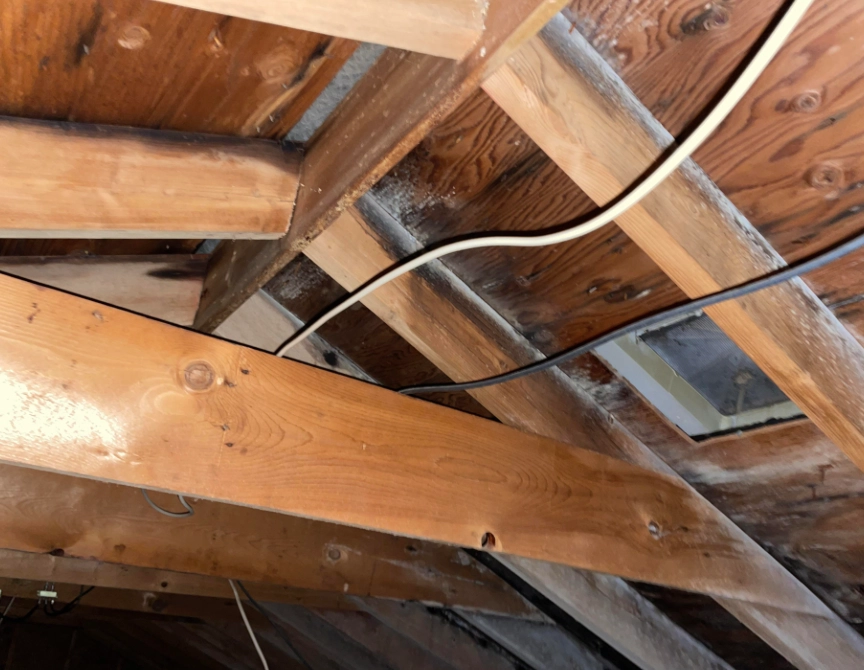
Attic mold shows up when heat and moisture get trapped under the roof with nowhere to escape, usually because of poor ventilation, and it spreads fast in a Florida summer where attic temperatures and humidity both run high. Removal costs vary depending on how far it’s spread, but the remediation process follows a set path: assess, contain, remove, verify. Below, we’ll cover what causes it, what the process actually looks like, and the early signs worth catching before it spreads.
How Poor Attic Ventilation Leads to Mold Growth in Florida Homes
Poor attic ventilation leads to mold growth by trapping warm, moist air under the roof deck instead of letting it escape, and that air condenses on cooler surfaces overnight. Florida’s humidity makes it worse: an attic without enough intake and exhaust venting can run hot and stay damp at the same time, exactly what mold needs to take hold.
Most attics need a balance of intake vents, usually soffit vents, and exhaust vents near the ridge, so air actually moves through the space instead of just sitting there. When intake gets blocked, often by insulation stuffed too close to the eaves, or exhaust is undersized for the attic’s square footage, moisture has nowhere to go. It just condenses, drips onto insulation, and gives mold a food source it wouldn’t otherwise have.
| Vent Type | Location | Function |
|---|---|---|
| Soffit vents | Under the roof eaves | Intake, pulls fresh air into the attic |
| Ridge vents | Along the roof peak | Exhaust, lets hot, moist air escape |
| Gable vents | On the attic’s end walls | Secondary exhaust or intake depending on design |
| Turbine vents | Roof-mounted, wind-powered | Exhaust, pulls air out using wind rotation |
| Powered attic fans | Roof or gable-mounted | Exhaust, actively pushes hot air out |
- Blocked soffit vents that cut off fresh air intake at the eaves
- Undersized or damaged exhaust vents near the roof ridge
- Bathroom or kitchen exhaust fans that vent into the attic instead of outside
That last one catches a lot of homeowners off guard. A bathroom fan that’s supposed to vent outside but was never properly connected just dumps warm, humid air straight into the attic every time someone showers. Over months, that’s a steady moisture source feeding mold growth on the roof sheathing directly above the bathroom, which is often where inspectors find the first patch.
An attic that breathes properly rarely grows mold on its own. One that can’t is basically waiting for a hot, humid week to make it official.
Attic Mold Remediation: From Assessment to Post-Verification
Attic mold remediation moves through four stages: assessment to determine how far the mold has spread and why, containment to keep spores from moving into the living space below, removal and treatment of affected materials, and post-verification testing to confirm the attic is actually clear. Skipping post-verification means nobody actually knows if the job worked.
Assessment is where a lot of the real information comes out. A mold inspection company checks not just where mold is visible but what’s feeding it, ventilation, a roof leak, insulation holding moisture, since removing mold without fixing the cause just buys time before it comes back. Attic mold remediation cost depends heavily on what that assessment finds, not just square footage.
- Containment barriers sealing the attic access point during work
- HEPA vacuuming and treatment of affected roof sheathing and framing
- Insulation removal and replacement when it’s absorbed too much moisture to save
Post-verification is the step some cheaper attic mold removal services skip, and it’s the one that actually matters most. A mold testing company or the remediation crew itself runs air or surface sampling after the work to confirm spore counts are back to normal, not just that the visible mold is gone. Without that step, professional attic mold removal is really just a guess dressed up as a finished job.
The remediation jobs that hold up are the ones that end with a test, not just a walkthrough and an invoice.
Detecting Attic Mold Early: Signs Every Homeowner Should Recognize
Attic mold shows up as dark staining on roof sheathing or rafters, a musty smell noticeable from the attic access or even a floor below, and sometimes visible moisture or condensation on nails and metal fixtures. Catching these signs during a routine check beats finding out during a home inspection before selling.
Most homeowners only go into the attic once a year, if that, which means mold usually gets a real head start before anyone notices. A quick check twice a year, especially after summer, catches staining or a smell before it turns into a remediation job instead of a five-minute cleanup.
- Dark or black staining on the underside of roof sheathing, especially near vents or bathroom exhaust lines
- Visible moisture or rust on nails poking through the roof deck, a sign of condensation buildup
A mold remediation specialist looking at early-stage attic mold has a lot more options than one called in after months of unchecked growth. Small, contained staining might need spot treatment and a ventilation fix. Widespread growth across the roof deck usually means removing and replacing insulation, sometimes sheathing too, which is a bigger job and a bigger bill either way.
The five minutes it takes to stick your head into the attic twice a year is a lot cheaper than the alternative.
Frequently Asked Questions
How much does attic mold removal cost?
Attic mold removal cost depends on how much of the roof deck and insulation is affected and whether a ventilation issue needs fixing alongside the cleanup. A small, contained patch near one vent costs far less than mold spread across the entire roof deck. Most companies won’t quote attic mold remediation cost over the phone since they need to see the extent of the growth and the condition of the insulation first.
How do I fix poor attic ventilation causing mold?
Fixing ventilation usually means balancing intake and exhaust, adding or clearing soffit vents at the eaves and making sure exhaust vents near the ridge aren’t blocked or undersized for the attic’s square footage. Any bathroom or kitchen fans venting into the attic instead of outside need to be corrected too, since that’s a constant moisture source. A mold remediation company can typically identify the specific ventilation gap during the same visit as the mold assessment.
What are the early signs of attic mold?
Dark staining on the underside of roof sheathing or rafters is usually the first visible sign, often near vents, bathroom exhaust lines, or areas with poor airflow. A musty smell noticeable from the attic access, sometimes even a floor below, often shows up before the staining does. Checking the attic twice a year, especially after summer, is the easiest way to catch these signs before they turn into a bigger remediation job.
Is it safe to remove attic mold myself?
A very small, isolated spot might be manageable with basic precautions, but attics are tight, poorly ventilated spaces that make DIY cleaning both physically difficult and risky to breathe in without proper protection. Skipping the ventilation fix, which most DIY attempts do, means the mold typically comes back within a season regardless of how thorough the cleaning was. Professional attic mold removal addresses both the mold and the cause at the same time.
Does attic mold affect selling a home?
Yes, attic mold found during a pre-sale inspection can delay closing or give a buyer leverage to negotiate repairs, so addressing it before listing is usually the smoother path. Documentation from a certified mold remediation specialist, including post-verification testing results, gives sellers something concrete to show buyers and their inspectors. Mold inspection and remediation completed well before listing tends to avoid last-minute negotiations that can derail a sale.